|
Piper
PA28 Cherokee
Warrior Parts
Check
|
Click letter for info
Highlight box for name |
|
|
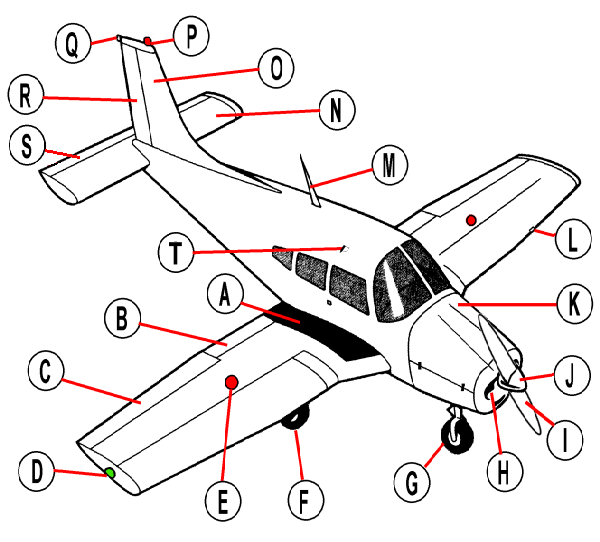 |
A |
wing-walk
|
| B |
flap
|
| C |
aileron
|
| D |
wing-tip
light
|
| E |
fuel-tank
cap
|
| F |
main-wheel
|
| G |
nose-wheel
|
| H |
air
intake
|
| I |
propellor
|
| J |
spinner
|
| K |
cowling
|
| L |
stall
warner
|
| M |
radio aerial
|
| N |
tailplane
|
| O |
tail-fin
|
| P |
flashing
beacon
|
| Q |
tail-light
|
| R |
rudder
|
| S |
elevator
|
| T |
door-lock
lever
|
Download
a quiz (75KB pdf)
A
Wing-walk: Rough, non-slip surface on strengthened
part of wing for walking.
B
Flap: Small amounts are used to increase lift for landing and take-off,
while larger angles increase drag for landing.
C
Aileron: There is one on each wing, and one moves up and
the other down to roll the plane for turns.
D
Wing-tip
light: Navigation lights so other pilots can
work out which way you are heading at night. Green on the right
(starboard) wing and red on the left (Port) wing.
E
Fuel-tank cap: It's important to ensure it is firmly on after you check
the level each flight.
Go
back to picture
F
Main-wheel: The undercarriage on this plane is a tricycle type - it has 2
main-wheels and one nose-wheel.
G
Nose-wheel: This may be steered by the rudder pedals, or free to turn like
a supermarket trolley, when brakes on each main-wheel might be used for
steering.
H
Air-intake: This is vital for cooling the engine and supplying air for
burning the fuel, and must be checked clear of debris before starting up.
I
Propellor: Keep clear at all times to save serious injury. Even when
engines are off, a propellor can suddenly turn if there is an ignition fault.
J
Spinner: This protects the hub of the propellor and makes it more
streamline.
Go
back to picture
K
Cowling: This fits closely to the engine so air can flow very near to the
hot parts to cool them. It also streamlines the engine to reduce drag.
L
Stall-warner: When the plane is flying too slowly, and is in danger of
stalling, the small vane in this device flips up and sets off a warning light
and horn in the cockpit.
M
Radio aerial: There are often several radio sets on board; two
transmitter/receivers and a number of radio navigational aids. Some small
planes might just use a hand-held transmitter/receiver.
N
Tailplane: This helps the aircraft fly level. On this plane it tilts
up and down and is called a stabiliser, but on other sorts of planes it is fixed
and an elevator does that job.
O
Tail-fin: This keeps the aircraft heading straight, though in a strong
side-wind, it can make it more tricky.
Go
back to picture
P
Flashing beacon
(red): This warns other planes if they are close
enough. Very bright flashing lights might also be fitted on the wing
tips. A plane on the ground may start its beacon flashing just before
starting its engines.
Q
Tail-light: This white light is visible from behind to warn a following
aircraft of the plane in front.
R
Rudder: This allows the plane to steer left or right. It may
be used to work with the ailerons in turns.
S
Elevator: This makes the plane pitch more nose-up or nose-down to adjust
the attitude. On this plane it is used to help adjust the stabiliser
(moving tailplane) and is called a trim-tab (anti-servo tab actually).
T
Door-lock
lever: This can be opened from inside or outside, but is
designed to seal the door tightly and prevent it opening accidentally.
Download a
quiz (75KB pdf)
Home
© Youth & Education Support 2005