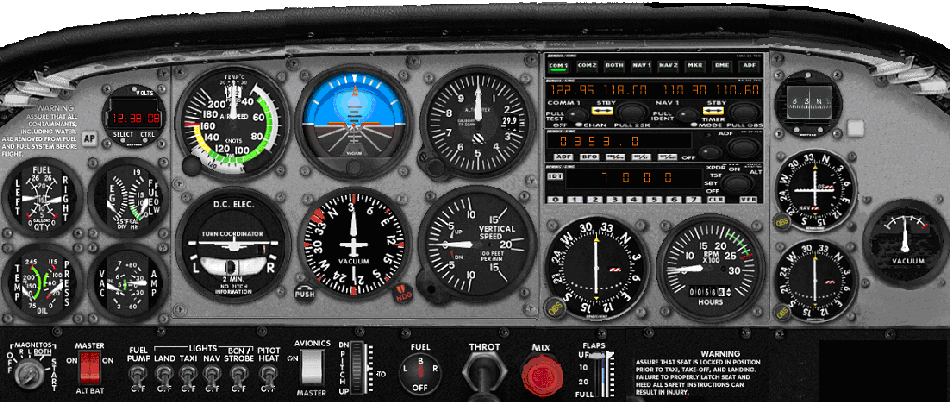
Aircraft Instruments and What They Do
Point mouse to see label; click to read description
| Airspeed Indicator (ASI) | Shows speed of airflow in knots kt (nautical miles per hour), kilometers per hour kph, or (statute) miles per hour mph. |
| Altimeter | Shows altitude, usually with reference to sea level, but can be adjusted to local pressure to give height above the ground. Above about 3000' is usually set to 1013 mb or 29.92", depending on its units. |
| Attitude Indicator (AI) or Artificial Horizon (AH) | Displays angle of pitch (nose-up or -down) and angle of bank of aircraft. |
| Clock | Adjust to GMT (Zulu) or zero at start to show total flight time. |
| Digital Measuring Equipment (DME) | Measures the distance from a beacon and can display the bearing (VOR/DME). |
| Direction Indicator (DI) or Heading Indicator (HI) | Shows direction or heading; may
need readjustment from time to time as the internal gyroscope gradually
moves its axis of rotation. Responds quickly as the aircraft turns,
unlike the magnetic compass. |
| Exhaust
Temp and Fuel low gauges |
Helps monitor the engine and the fuel burn. |
| Fuel Gauges | Gives an idea of how much fuel is left in each tank. Pilots do a calculation on how much fuel they will need for a flight, and allow 45 minutes of reserve. NEVER assume the gauge is accurate - ALWAYS check the actual tank levels before a flight. |
| Magnetic Compass | Displays direction compared with magnetic north;
better placed away from the electrical instruments and well clear of steel
items. Used to check the DI from time to time. Needs its error
checking at the main compass points if you modify the instrument panel,
and from one year to the next. |
| Manifold
Pressure Gauge and Ammeter |
Helps adjust the mixture when at height, and the ammeter allows a check on the rate of battery charging. |
| Navigation Instruments |
A wide variety of instruments to show radio, satellite, or inertial navigation information |
| Oil Temperature and Pressure Gauges | Gives information about the engine state, and a warning if oil is being lost or the engine is overheating. |
| Radio Selector; | Switch array to select which channel of COM1, COM2, NAV1 or NAV2 is being received |
| Radio Stack | Contains communications and navigational radios; |
| Suction or Vacuum Gauge | Shows the amount of Suction or Vacuum present for the vacuum-driven instruments |
| Tachometer | Indicates engine speed in revolutions per minute (RPM) |
| Transponder | Communicates with ground-based radar by sending down information for identification and height |
| Turn and Slip Indicator | Shows the way the aeroplane is turning, and how out of balance it is |
| Vertical Speed Indicator (VSI) | Indicates rate of climb or descent, usually in feet per minute |
| Home |
© Youth & Education Support 2005 - 2010 |